Showing posts with label Wines of France. Show all posts

Rosé Rising: “Joie de Vivre, Bottled”


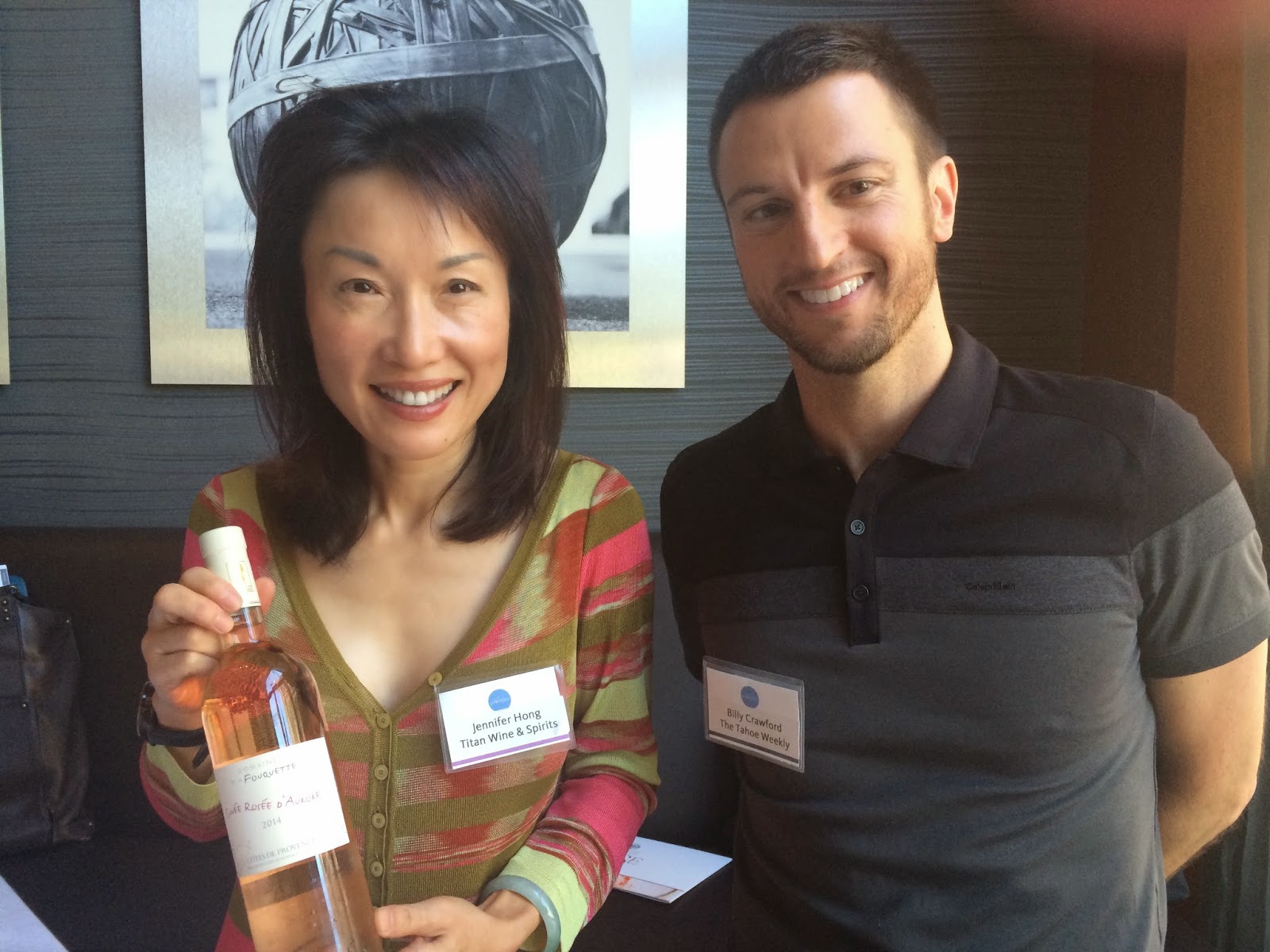
Jennifer Hong, representative of Rosée d’Aurore distributor,
visits with Billy Jim Crawford, founder, soon-to-launch Club Botanic,
(an online fresh bouquet service, delivered weekly)
at the Vins de Provence tasting in San Francisco in early March.
Guest Author: Nicole Zaro Stahl


Forget all those old notions about rosé wine—that it’s sugary-sweet, that it’s produced as an afterthought by mixing excess red and white grapes. Au contraire! This frequently misunderstood category stands on equal footing right alongside its red and white counterparts. In fact, today rosé accounts for some 30% of total wine consumption in France, where it was first crafted more than 2,000 years ago.

Americans are catching onto the trend. U.S. retail sales of imported rosé wines have grown by double digits in each of the past 10 years. A substantial number of the imported labels hails from Provence, the romantic landscape of alternating hills, gorges, and lush river valleys that runs 150 miles inland along the sun-kissed French Mediterranean coast.

The largest rosé-producing region in the world, Provence presents a mosaic of terroirs hospitable to the grape varieties most commonly cultivated to give the authentic blush wine its refreshingly crisp, dry taste: Grenache, Cinsault, Syrah, Mourvėdre, Tibouren, Cabernet Sauvignon. The grape skins are removed before fermentation to attain the characteristic pale pink color and fruity aroma.

In large part, rosé’s surging popularity can be attributed to its versatility. From ski slopes to sailboats, rosé is in demand year-round as an apéritif, accompanying the main meal, or with dessert. The price point is attractive, too: many Provence wineries export AOP (Appellation d’Origine Protégée) vintages that sell for $20 a bottle or less at retail.

Here are three 2014 rosés well worth decanting.

Château d’Esclans was established by Sacha Lichine, son of Alexis Lichine, the legendary wine expert and author of the Encyclopedia of Wines and Spirits. While the domaine’s chalky-clay slopes produce some of the world’s most exclusive rosés, “Whispering Angel” Côtes de Provence Rosé 2014, at $20 per bottle, offers a pleasantly affordable entrée into the highly esteemed brand. Described as a “chameleon,” the 13%-ABV Whispering Angel will compliment any meal, from seafood or steak to barbecue or pan-Asian cuisine.

In addition to its unique terroir of schist and clay soil, Domaine de la Fouquette is known for “green” growing and harvesting practices. The estate’s pale and fruity Rosée d’Aurore Côtes de Provence 2014 boasts intense, complex flavors of citrus. This is the rosé to serve at cocktail hour with nibbles of olive tapenade or for mains like bouillabaisse, the classic Provençal fish stew. The 12.5%-ABV Rosée d’Aurore sells for less than $20 per bottle.

The four Brun brothers, the third generation at the helm of Château de Brigue, blended the latest technology (including the use of screw caps) with the agronomic savoir-faire of their engineer father to produce Brigue Provence Côtes de Provence 2014. This entry-level rosé (12.5% ABV), which retails at $13.50 per bottle, offers notes of lemon, pear, grapefruit, and mineral. The fruity, fresh and balanced wine pairs well with fish, seafood, poultry, stews, fresh vegetables, and other Mediterranean classics.

So the next time you’re debating between red and white, think pink instead, and chose a rosé. A votre santé!
 
About our Guest Author: 
Nicole Zaro Stahl is a professional business writer based in San Francisco who covers food, beverage, technology, distribution, and logistics topics.
 

Rosé from Provence - After the Local Tasting, I want to Go THERE


To misquote Gertrude Stein, “A Rosé is a Rosé is a Rosé”, except of course when it is a Rosé from Provence in which event it is an exceptionally drinkable and well-priced Rosé.  That was my recent experience tasting Rosés from Provence at a tasting in San Francisco where 21 producers showcased their wines.  Rarely do Provence Rosés exceed 13 percent alcohol, or $25 retail.  Provence is the world’s largest wine region specializing in Rosé wines.

Emilie Perananda of
Chateu de Saint-Martin
The 2013 Grande Reserve Cru Classe Rosé from Chateau de Saint-Martin is produced from a blend of  Grenache, Tibouren, Cinsault, Carignan and Syrah.  It’s a bright peach-lychee color and has an intense aroma of dried flowers and fruitiness. The taste is delicate and silky with peach and pomegranate prevailing.  This winery has been in the same family since 1740, and has always been managed by women, with the ownership passing from countess to countess.  12.5 percent alcohol.  Suggested retail price is $22.00 the bottle.  Only 10,000 bottles are available in the US.  www.chateaudesaintmartin.com


Jana Manfredi pours for
Domaine de la Fouquette
The 2013 Rosée D’Aurore from Domaine de la Fouquette is a blend of 65% Grenache, 30% Cinsault and 5% Rolle.  The intense citrus aroma of this wine leads to a taste that is fruity and fresh, with notes of honeysuckle to enhance the experience.  This small production vineyard is in the heart of the Côtes de Provence appellation.  12 percent alcohol.  $17.99/bottle suggested retail price.   www.domainedelafouquette.com


Liz Comte-Monk for
Maitres Vignerons de Saint Tropez
Maitres Vignerons de Saint Tropez is a large volume producer and you may easily find their 2013 Saint Roch Les Vignes Rosé in the market.  This yummy blend of Grenache and Cinsault has a beautiful salmon-colored hue, and an aroma that is dominated by floral and herbal tones  It is fresh tasting with a grapefruit highlight.  13 percent alcohol.  $15/bottle suggested retail price.   www.vignerons-saint-tropez.com


Sophie Estrada of Prospect
pours i Pink
Chateau de L’Escarelle is another large volume producer, and I PINK is their aperitif style Rosé blended from 50 % Cinsault and 50% Grenache grapes.  It is light pink in color, and the aroma of grapefruit leads you to a taste of peach and exotic fruits.  This light and floral wine is 12.5 percent alcohol, and retail price will be around $10.   www.escarelle.fr


Eric Kurver, Owner/Winemaker
at Aix, Saint Aix
AIX Rosé is produced from an old vine 73-hectare vineyard in the appellation Coteaux d’Aix-en-Provence.  It is a blend of 60% Grenache, 20% Syrah and 20% Cinsault and is fresh tasting with bright fruit flavors, floral notes and nice minerality. More than 150,000 bottles are earmarked for the USA, so you might find it easily.  13 percent alcohol, suggested retail price is $18-20 dollars per bottle.   www.aixrose.com
 
 
A FEW STATISTICS ABOUT PROVENCE AND ITS ROSE:
The USa, surpassed only by France, ranks second in the world in Rosé consumption with 13% of total consumption in 2011.  2011 global consumption was 22.4 million hectoliters.  The US market has grown at double-digit rates in each of the last 10 years… and from nov 2012 to nov 2013, exports of Rosé from Provence to the US jumped 40% on both volume and value.  
The most common Rosé grapes in Provence are Grenache, Cinsault, Syrah, Mourvedre, Tibouren, Carignan and Cabernet Sauvignon.
 
Appellations in Provence, and their percentage production of Provence Rosé:
Cotes de Provence = 75%
Coteaux d’Aix-en-Provence = 15%
Coteaux Varois en Provence = 10%
Of all wine produced in Provence, Rosé = 88.5% of total production; reds = 8%, and whites = 3.5%
I loved visiting the websites of the producers, and hope to travel there someday!

Amazing Wine-Dine Experience at Restaurant Trokay in Truckee, CA

An unforgettable wine-food pairing experience waits for you at Restaurant Trokay in downtown Truckee.  I’m hoping to raid my piggy-bank so I can go again and enjoy the exquisite food and perfectly-paired wines presented by John and Nyna Weatherson at this very classy restaurant.  A word to the wise: allow plenty of time for the total experience.

Their website, restauranttrokay.com, refers to “superlative customer service” and that is simply an understatement.  From the time we were seated for dinner and paired wines until we stood up three hours later, everything was orchestrated to enhance our palate and assure the wine was just right in terms of temperature, presentation and timing.

Sorelle Bronca di Valdobbiadene Prosecco
We began with the Italian Prosecco from Sorelle Bronca di Valdobbiadene Superior D.O.C.  This extra-dry bubbly had apricot, pear and apple as its predominant flavors, an aroma of pear and apple, and the sweetness and fresh acidity  make it delicious by itself or as an appetizer wine.  11 per cent alcohol.  $12/glass, $38/bottle.

Prager's Gruner Veltliner
 
 
Grunerveltliner is a food-friendly wine, and Trokay makes it a practice to always have one on the wine list.  The one we tasted was from Austria, the Prager's 2011 Grüner Veltliner Federspiel Hinter der Burg.  The name "Hinter der Burg", which has not been changed since the 13th century according to wine importer WineBow, means behind the old castle Weissenkirchen.   Coaxed out of a 7 acre vineyard, this wine has aroma of citrus, spice and green apple, and taste of citrus with a pleasant herbal not and a good minerality. 12.5 per cent alcohol, $67/bottle.

Fans of Japanese sake too, the Weatherson’s presented the Rihaku (Dreamy Clouds) Junmai Tokubetsu Nigori Sake.  “Aromas of rice and ripe red plums. Bright, mouthwatering acidity leads to a soft and chewy texture from the unfiltered rice particles. The rice flavor is joined by gentle nutty and slightly fruity flavors in the long finish,” notes the winemaker. 15.5 per cent alcohol.


The 2010 Sauvignon Blanc from Gamble Family Vineyards in Napa has an aroma that is fresh and inviting, with notes of apricot, green apple and musky melon.  The flavor follows on with taste of mango, honeysuckle and candied orange, and layers of citrus and minerality.  13.5 per cent alcohol.  $10/glass, $35/bottle.


One of my favorite wines are those from the Languedoc region of France, and here at Trokay I tasted the 2012 Domaine de Nizas Rose blend of Grenache, Syrah and Mourvedre.  Delicious.   It is lush and lively, with aroma of strawberry, raspberry and spice.  Additional flavors of melon, orange zest, and a crisp and medium body.  14 per cent alcohol.  $10/glass, $37/bottle.


E Guigal Gigondas Rose;
Sequoia Grove Chardonnay

The tasting and food pairing went on and on… as it should in a fine dining restaurant.  Other wines we tasted were the 2009 E. Guigal Gigondas , a Rhone blend of a blend of 65% Grenache, 25% Mourvèdre, and 5% Syrah;  the 2011 Chardonnay from Sequoia Grove, Napa;  and the final touch was the 2010 Donnafugata Ben Rye Passito di Pantelleria, a sweet wine from Sicily.


Restaurant Trokay is located at 10046 Donner Pass Road, Truckee.  No reservations required at their wine bar, but for the full dining-wine experience, reserve at 530 582 1040.


This information first appeared in The Tahoe Weekly newspaper, where I write the Wine Time column, in August 2013  

Tasting with Baron Eric de Rothschild

A great way to learn about a wine is to meet the owner of a winery who is involved in every aspect of producing the wine, from selecting the vines, to determining the use of the land, to giving the go-ahead for harvesting, to tasting, tasting and tasting.   And when this person is Baron Eric de Rothschild of the famous Bordeaux winery Chateau Lafite, it’s a very interesting learning experience indeed.

Lafite is one of the leading wines in the world, sought after by wine connoisseurs.   In 2012 in France, a bottle of Chateua Lafite Pauillac grand cru reached the price of 936 Euros, or roughly $1300.  Wisely, the company has used its great reputation to create a collection of wines under the umbrella of Domaines Barons de Rothschild.   Since 1974, they have moved from producing wine at only one Bordeaux Chateau to several Bordeaux Chateaux, acquired an estate in Chile, entered into a partnership in Argentina, acquired a property in the Languedoc region of South France, and are looking at producing in China too. 
At the Agribusiness Seminar at Harvard Business School in January, Baron Eric selected three wines for our group’s dinner, all readily available.

 2008 Bordeaux, Chateau Duhart-Milon, Domaines Barons de Rothschild (Lafite),  from the Paulliac region of Bordeaux, France.  This classic Bordeaux blend has delicate aroma of blueberry and cedar, and hints of smokiness.  It is delicate on the palate too, with black currant and cedar flavors.  13.7 percent alcohol.  Internet prices between $80-100.
2009 Cabernet Sauvignon/Malbec blend, Bodegas Caro, Domaines Barons Rothschild & Nicolas Catena, Argentina.  A dense, complex wine with good tannic structure.  The lingering tannin gives the wine good length and a pleasant, soft mouthfeel.   Deep, aromatic and with very appealing intense fruit.   14.5 percent alcohol.     $35-40 internet price.

2011 Reserve Speciale Bordeaux Blanc, Domaines Barons Rothschild, France.  The blend is 40/60 Sauvignon Blanc and Semillon.  On the nose, the wine is aromatic, dominated by aroma of tropical and citrus fruits like grapefruit and lime. Sauvignon grapes give flavor and liveliness, while the Semillon grapes give fullness and balance at the end.   12 percent alcohol.   $15 internet price.
To taste Rothschild wines in the Lake Tahoe area, stop into L'uva Bella Wine Gallery at 13925 South Virginia St. in Reno.  Not long ago, they did a pouring of five Rothschild wines, none costing more than $19 a bottle:  Los Vascos Sauvignon Blanc, Chile; Bordeaux Blanc,  Baron Rothschild Collection, France;  Chateau Paradis Casseuil , France,  Bordeaux  (red blend); Amancaya Malbec , Argentina, a 70/30 blend of Malbec and Cabernet; and Los Voscos Cabernet ,  Chile. 


This information first appeared in The Tahoe Weekly newspaper, where I write the Wine Time column, on February 28, 2013   

Meeting Baron Eric de Rothschild and Tasting His Wines

A great way to learn about a wine is to meet the owner of a winery who is involved in every aspect of producing the wine, from selecting the vines, to determining the use of the land, to giving the go-ahead for harvesting, to tasting, tasting and tasting.   And when this person is Baron Eric de Rothschild of the famous Bordeaux winery Chateau Lafite, it’s a very interesting learning experience indeed.

Lafite is one of the leading wines in the world, sought after by wine connoisseurs.   In 2012 in France, a bottle of Chateua Lafite Pauillac grand cru reached the price of 936 Euros, or roughly $1300.  Wisely, the company has used its great reputation to create a collection of wines under the umbrella of Domaines Barons de Rothschild.   Since 1974, they have moved from producing wine at only one Bordeaux Chateau to several Bordeaux Chateaux, acquired an estate in Chile, entered into a partnership in Argentina, acquired a property in the Languedoc region of South France, and are looking at producing in China too. 

At the Agribusiness Seminar at Harvard Business School in January, Baron Eric selected three wines for our group’s dinner, all readily available.

 2008 Bordeaux, Chateau Duhart-Milon, Domaines Barons de Rothschild (Lafite),  from the Paulliac region of Bordeaux, France.  This classic Bordeaux blend has delicate aroma of blueberry and cedar, and hints of smokiness.  It is delicate on the palate too, with black currant and cedar flavors.  13.7 percent alcohol.  Internet prices between $80-100.

2009 Cabernet Sauvignon/Malbec blend, Bodegas Caro, Domaines Barons Rothschild & Nicolas Catena, Argentina.  A dense, complex wine with good tannic structure.  The lingering tannin gives the wine good length and a pleasant, soft mouthfeel.   Deep, aromatic and with very appealing intense fruit.   14.5 percent alcohol.     $35-40 internet price.

2011 Reserve Speciale Bordeaux Blanc, Domaines Barons Rothschild, France.  The blend is 40/60 Sauvignon Blanc and Semillon.  On the nose, the wine is aromatic, dominated by aroma of tropical and citrus fruits like grapefruit and lime. Sauvignon grapes give flavor and liveliness, while the Semillon grapes give fullness and balance at the end.   12 percent alcohol.   $15 internet price.

To taste Rothschild wines locally, stop into L'uva Bella Wine Gallery at 13925 South Virginia St. in Reno.  Not long ago, they did a pouring of five Rothschild wines, none costing more than $19 a bottle:  Los Vascos Sauvignon Blanc, Chile; Bordeaux Blanc,  Baron Rothschild Collection, France;  Chateau Paradis Casseuil , France,  Bordeaux  (red blend); Amancaya Malbec , Argentina, a 70/30 blend of Malbec and Cabernet; and Los Voscos Cabernet ,  Chile. 


Vins du Languedoc: Great Tastes, Fabulous Values

One of the best wine tasting events I’ve been to all year was the one featuring Languedoc AOC wines, where I tasted wines made from grapes that were unfamiliar to me and learned about the fascinating history of this wine region.


Below is a look at just a few of the 31 wines that were poured.  I was impressed with the aroma, taste and food-friendliness of all that I tasted.

Chateau du Donjon’s 2010 Rosé comes from a vineyard situated in Minervois, one of the oldest wine-producing areas in Languedoc.  Owned by the same family for 500 years, winemaker Jean Panis produced a ripe, soft and aromatic wine composed of 30% Syrah, 30% Cinsault, 40% Grenache.  A lovely pink-salmon color, the aroma is a fruit bowl of strawberries, red cherries and red plums.  The flavor is intense and echoes the fruit aroma, and the finish is dry and well balanced.  12.5 percent alcohol.  Average internet price (wine-searcher.com) is $14.

Domaine la Croix Chaptal
, Les Terrasses Rouge, 2007 is produced on an estate that formerly belonged to Gellone Abbey, founded in 804. Winemaker Charles Pacaud’s red wine combines Grenace and Carignan with a touch of Syrah. The taste is of dark fruits that follow the aroma of cherry and perhaps coffee. It is spicy and fresh, and representative of the Terrasses du Larzac area wines. This growing area is in the western part of the rural district of Saint Andre de Sangonis, about 20 miles northwest of Montpellier, a popular tourist destination due to old abbeys and natural caves. Alcohol is low: 13 percent “because we have an especial terroir which expresses the grapes and so we have flavor at lower alcohol,” according to Pacaud. Price around $20 a bottle. Distributed by www.usawinewest.com or call (415) 331-4906 to find out where to buy it; it’s worth the hunt.


Piquepoul is a wine grape with which I wasn’t familiar before this tasting. About 3,000 acres of the light-skinned Piquepoul blanc are cultivated in France, and it is one of the oldest domestic grape varieties in Languedoc. Although the name means “lip stinger” because these grapes have high acidity, I enjoyed the Domaine Felines Jourdan, Blanc 2009, Grand Vins du Languedoc. Aroma of white flower, a bit frizzante and a clear crisp taste. Delightful. 13 percent alcohol. $11 the bottle. You can find it at several California wine shops via www.wine-searcher.com


Chateau des Karantes, Blanc, 2009, AOC Languedoc, is a blend of 54 percent Bourboulenc, 14 percent vermentino, 16 percent Roussane and 16 percent Grenache Blanc. The result is a wine with aroma and taste of honey, lemon, fruit tones of apricot, a long finish and a nice balance between the fruit and acidity. Again, a new grape experience for me: Bourboulenc. Korbrand’s Web site notes that “Bourboulenc is an extremely old grape variety which is thought to have originated in Greece where it was known as the Asprokondoura. A late-ripening variety, it tends toward leanness and neutrality, but when picked at optimum maturity it retains high natural acidity and shows fresh citrus qualities with floral notes.” 13 percent alcohol. $30 by the bottle. Imported by Eagle Eye Imports at www.eagleeyebrands.com or call (248) 396-3589.


For more information about the Languedoc region, visit www.languedoc-wines.com.

~ ~ ~ ~ ~ ~
© 2011 Barbara Keck

For more information on dining and the wide range of activities around Lake Tahoe, see the online version of The Tahoe Weekly. This article appeared in my column "Wine Adventures" in August 2011.

Book in Process: "Mountain High Wine: The Sierra and Its Foothills".


Languedoc, located in the South of France, is the world‘s largest wine growing region and one of the oldest wine growing regions in France. “Today’s Languedoc is France’s wine frontier,” notes the Conseil Interprofessionnel des Vins du Languedoc, which sponsored the tasting. “Pioneering producers are employing both time-honored traditions and new techniques to craft wines of remarkable style and character, as well as excellent value.”